Vuelta 2025: GC Favourites
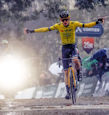 fotobureau Cor VosLa Vuelta promises another showdown between the best riders from the two strongest teams in the world: Visma | Lease a Bike and UAE Team Emirates. With the Tadej Pogacar absent, the race is set to be all the more exciting. Cyclingstage.com brings you the main contenders for the red jersey.
[The text below was written before the start of La Vuelta and has not been updated.]
Jonas Vingegaard has proven himself to be the best rider in the peloton over the past few seasons – bar one: Tadej Pogacar. That was the case once again in the Tour, just as it had been earlier in the Critérium du Dauphiné. The Dane has consistently been the best of the rest. So far this season, he’s only claimed one win: the Volta ao Algarve, back in February. In March, he looked set to take Paris–Nice before a crash forced him to abandon. He returned to competition at the Dauphiné. And now it’s on to the Vuelta a España, in the hope of salvaging his season with a touch of red.
João Almeida, on the other hand, has racked up plenty of racing this year. He often competed when Pogacar did not, allowing the Portuguese rider to chart his own course. That led to overall victories at the Itzulia Basque Country, the Tour de Romandie, and the Tour de Suisse. In the Tour de France, he started as Pogacar’s super-domestique, but a heavy crash forced him to withdraw before the race reached the mountains.
In the Vuelta, Almeida shares leadership with Juan Ayuso. Like Vingegaard and Almeida, the Spaniard is an outstanding all-rounder. All three are strong time triallists and excellent climbers, and they’ve got enough of a kick to contest stage wins at the end of tough days. Still only 22, Ayuso won Tirreno–Adriatico earlier this year and went into the Giro d’Italia as one of the top favourites. But after crashing, things fell apart. He did win the first uphill finish, but never made it to the final stage in Rome.
The other major spring stage race, Paris–Nice, was won by Matteo Jorgenson. The American from Visma | Lease a Bike rode the Tour as a co-leader, the idea being to attack Pogacar from two angles. That didn’t pan out, simply because Jorgenson wasn’t strong enough. With Pogacar not on the start line, that tactic might prove more effective in the Vuelta, although Spain’s brutally steep summit finishes may not particularly suit the tall American.
Key battlegrounds
No fewer than ten of this year’s 21 Vuelta stages finish uphill, but that doesn’t necessarily mean they’re all brutal mountain stages. In many cases, the approach takes the riders over rolling or lumpy terrain.
Featuring an irregular final climb to the Cerler ski resort and more than 4,200 metres of elevation gain, stage 7 stands out as the toughest test of the opening week. The battle for red is then expected to truly ignite with the Angliru–La Farrapona double-header in week two. The stage to the Angliru packs nearly 4,000 metres of climbing, most of it crammed into the final 60 kilometres. The following day, the riders face 3,800 metres of elevation over just 135.9 kilometres. In both cases, the final climb is highly irregular, with long sections well into double-digit gradients.
Stage 17 is another tough one: 143.2 kilometres with nearly 3,400 metres of climbing. The final ascent, El Morredero, averages 6.3% over 18.1 kilometres, while there are plenty of double-digit ramps, making it anything but a steady grind.
The following day sees a flat 27.1-kilometre individual time trial in Valladolid. It’s a repeat of the course from two years ago, when Filippo Ganna took the win and Almeida was the fastest of the current GC contenders. Ayuso was 21 seconds slower, and Vingegaard 28. Then-race leader Sepp Kuss conceded 39 seconds, which wasn’t enough to threaten his red jersey and, ultimately, his overall victory.
The final big GC shake-up comes on the penultimate day, when the red convoy heads to the Bola del Mundo. In terms of elevation, this is the hardest stage of the entire Vuelta, with over 4,200 metres of climbing. The final ascent alone measures 12.5 kilometres at 8.5% on average, with the final 3.2 kilometres ramping up to an unforgiving 12.2%.
Grand Tour Winners
Sepp Kuss is the only rider on this year’s start list with La Vuelta on his palmarès; he won the race in 2023. Other GC winners include Jai Hindley, who won the Giro in 2022, and Egan Bernal, who claimed both the Tour (2019) and the Giro (2021). Jonas Vingegaard tops the lot with back-to-back Tour de France victories in 2022 and 2023.
Favourites 2025 Vuelta a España
**** João Almeida, Jonas Vingegaard, Juan Ayuso
*** Giulio Ciccone, Mikel Landa, Egan Bernal, Jai Hindley
** Felix Gall, Matteo Jorgenson, Ben O'Connor, Antonio Tiberi
* Jay Vine, Sepp Kuss, David Gaudu, Giulio Pellizzari, Lorenzo Fortunato