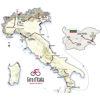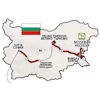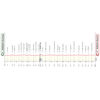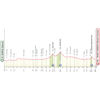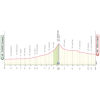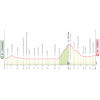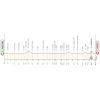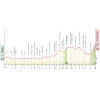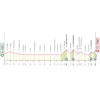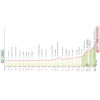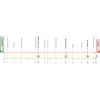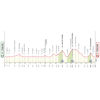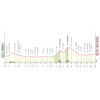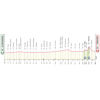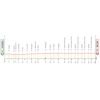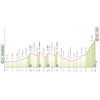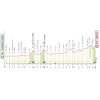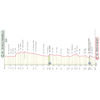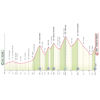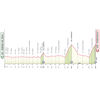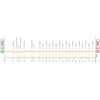
The Grande Partenza takes place on the Black Sea coast, in Nesebăr, with the 1st stage finishing in Burgas. The 2nd stage is more hilly and travels to Veliko Tarnovo, after which the 3rd stage heads from Plovdiv to the Bulgarian capital, Sofia. Sprinters are expected to shine during the opening weekend, while the second day promises a more selective route.
Following a transfer to southern Italy, the Giro continues with stage 4 through the Abruzzo region. Stage 5 is a hilly run to a punchy finale in Potenza, after which Naples is likely to form the backdrop to the 6th stage‘s bunch sprint.
The first summit finish is set for stage 7 at the Blockhaus. The 13.6-kilometre ascent averages 8.4%, with the final 10 kilometres ramping up to 9.4%. The Giro d’Italia last tackled the climb in 2022, with Jai Hindley emerging victorious ahead of Romain Bardet, Richard Carapaz, Mikel Landa, and João Almeida.
Crossing the Marche region, the 8th stage will be a ‘tappa dei muri’ with a punchy finale in Fermo, after which the 9th stage finishes at the Corno alle Scale, part of the wild, densely forested Bolognese Apennines. The last 3 kilometres go up at almost 10%.
Week 2
Time-trial specialists such as Remco Evenepoel will be in their element with stage 10, an individual time trial of roughly 40 kilometres along the Tuscan coast. Slightly further north, Chiavari on the Gulf of Tigullio (Liguria) hosts the finish of stage 11. A little further up the Gulf of Genoa, Imperia is the starting point of stage 12, which crosses the two modest mountain tops on its way to Novi Ligure.
Back in 2015, Philippe Gilbert was the last rider to win a Giro stage in Verbania, and it looks like a successor will be crowned on 22 May: stage 13 finishes in the birthplace of time-trial powerhouse Filippo Ganna.
Stage 14 serves up a series of climbs from the Aosta Valley. The riders finish by climbing to Pila – a final ascent of 15.9 kilometres at 7.3%. The following day, Milan is the terminus of the entirely flat 15th stage.
Week 3
The final week opens in Switzerland with a brutal mountain stage featuring nearly 3,000 metres of elevation gain in just 113 kilometres. Stage 16 takes the riders over four intermediate climbs to a summit finish in Carì. The final ascent to the mountain village averages 8% over 11.2 kilometres.
Stage 17 runs over flat to rolling roads before a hilly finale and a false flat finish in Andalo. Stage 18 passes through the vineyards of the Veneto in its closing phase, where the steep Muro di Ca’ del Poggio could well prove decisive.
The final weekend begins with a punishing high-mountain double. Stage 19 sends the riders over the Passo Duran, Passo Staulanza, Passo Giau and Passo Falzarego before finishing on the Piani di Pezzè – a leg-breaker of 5 kilometres at 9.8%. The next day, stage 20 runs from Gemona del Friuli to the ski station of Piancavallo. The finishing climb averages 7.8% over 14.5 kilometres, and to add to the fun, the riders must tackle it twice.
The final stage of the Giro starts and finishes, as in the past three editions, in Rome.
Giro d’Italia 2026: routes, profiles, more
Click on the images to zoom