Tour de France 2026 Route stage 2: Tarragona - Barcelona

Last updated 5 July
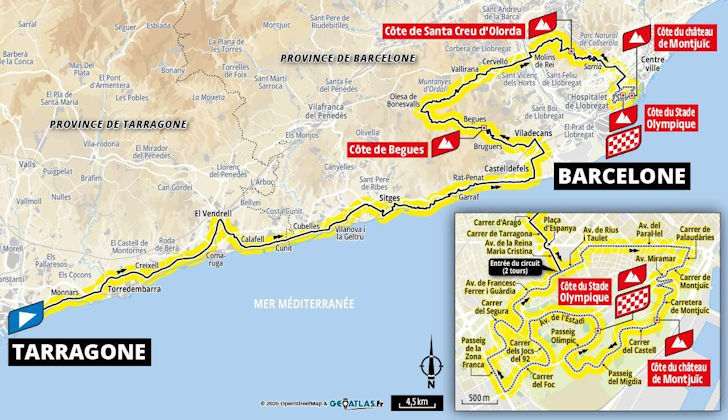
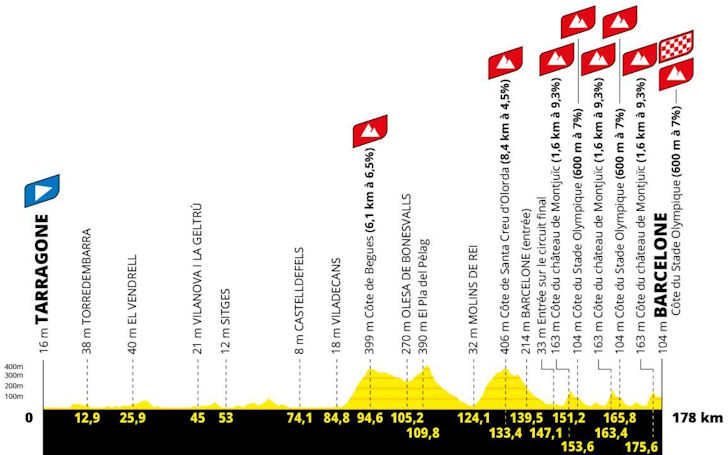
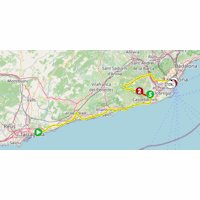
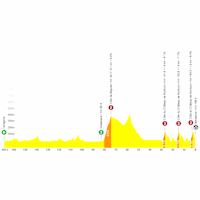
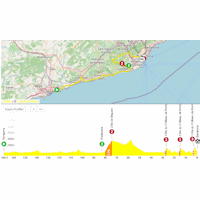
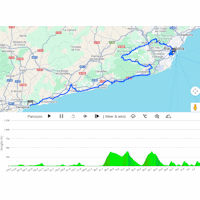
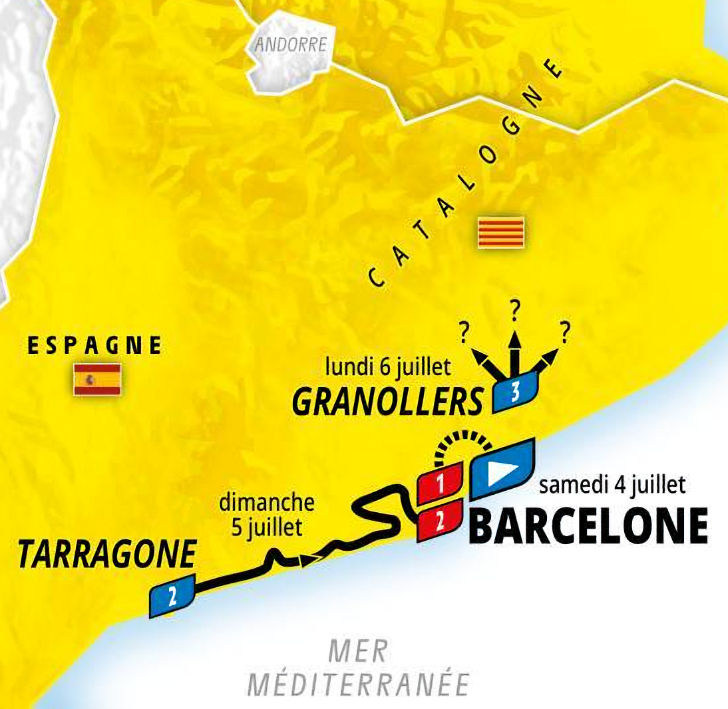
After starting in Tarragona, the riders head along 85 kilometres of flat roads on the Costa Dorada before turning inland towards Begues. To get there the road climbs for 6.1 kilometres at 6.5%. After Begues the road trends gently downhill for around 10 kilometres before another rise of 4.7 kilometres at 3.4% precedes the descent into the valley of the River Llobregat.
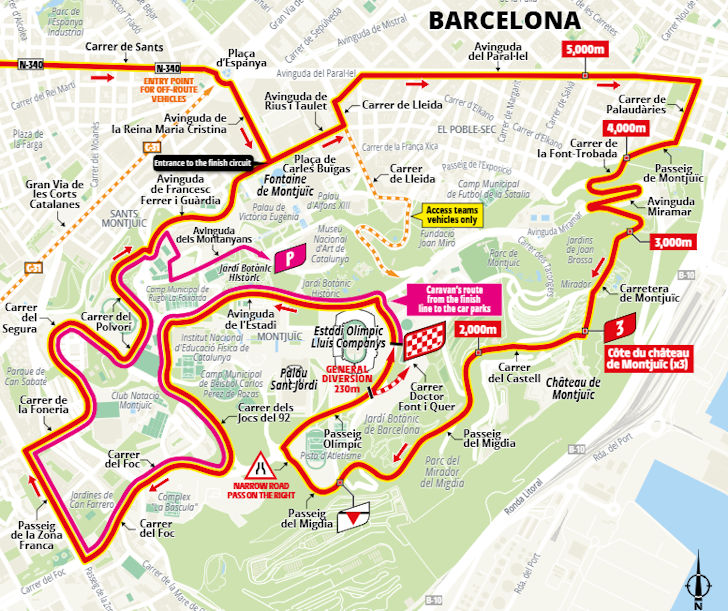
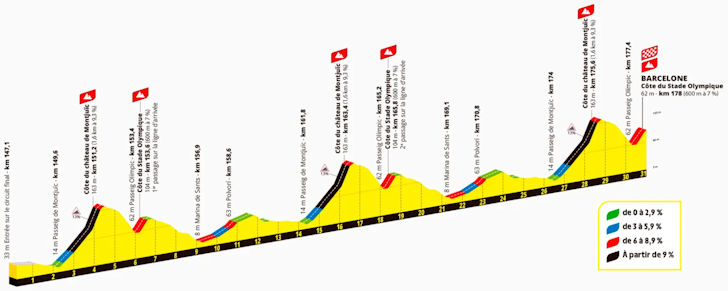
The valley is a major transport corridor that also carries the A-2 and B-23 motorways. The riders follow roads running parallel to these major arteries towards Barcelona, where they enter the finishing circuit with roughly 30 kilometres to go. The circuit twists and turns over Montjuïc, the hill overlooking the city.
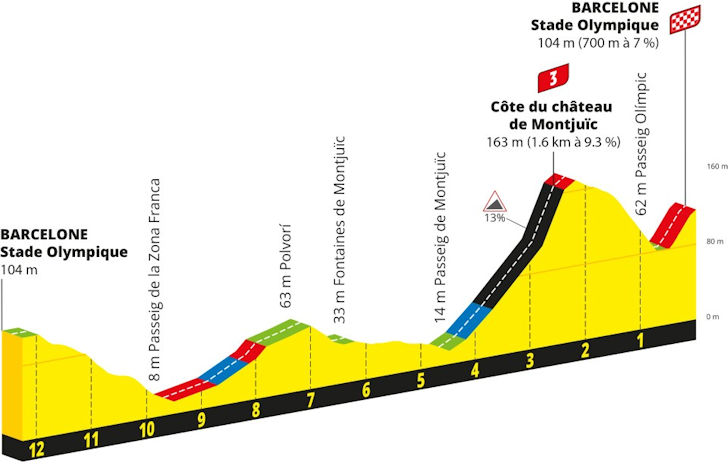
The first of two climbs on the circuit leads up to Montjuïc Castle, or, in good French, the Côte du Château de Montjuïc. It’s a real leg-breaker: 1.6 kilometres at 9.3%, with a maximum gradient of 13%. From the top, the road drops for just over 1 kilometre before rising again for 700 metres at 7% on the Côte du Stade Olympique.
At the first passage over the Côte du Stade Olympique, there are 24.4 kilometres to go — two identical laps of 12.2 kilometres each.
Each lap begins with a descent, followed by a rolling section leading onto the two climbs: first the Côte du Château de Montjuïc, then the Côte du Stade Olympique. The finish line is placed on that last ascent.
The Montjuïc circuit does overlap with the traditional finale of the Volta a Catalunya, but this course largely stands on its own. The punchy climb up to Montjuïc Castle, for instance, plays no part in the Catalan race, and the finish line is in a different location altogether.
Fancy riding the route yourself? Download GPX 2nd stage 2026 Tour de France.
Another interesting read: results 2nd stage 2026 Tour de France.
Tour de France 2026, stage 2: routes, profiles, videos
Click the images to enlarge







Comment
1 comment
Andrew Borowiec
Fantastic description and data! Is there a chance to add the gradient to the interactive maps like there is on the map for Stage 1?