Giro Women 2026: Route

First published on 25 May 2026
Race dates: Saturday 30 May – Sunday 7 June
Race type: Grand Tour
Favourites: Demi Vollering, Anna van der Breggen, Kasia Niewiadoma, Marlen Reusser, Elisa Longo Borghini
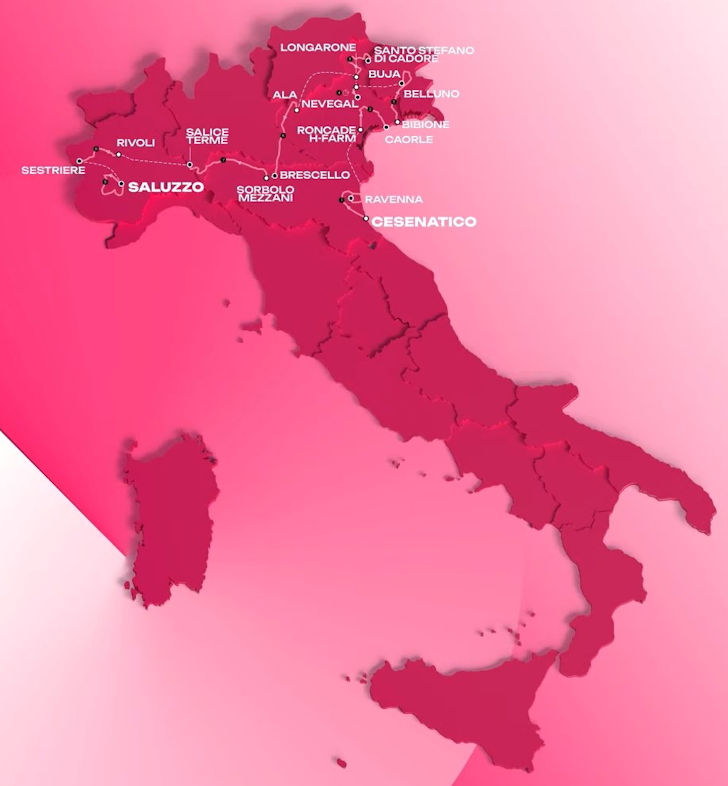
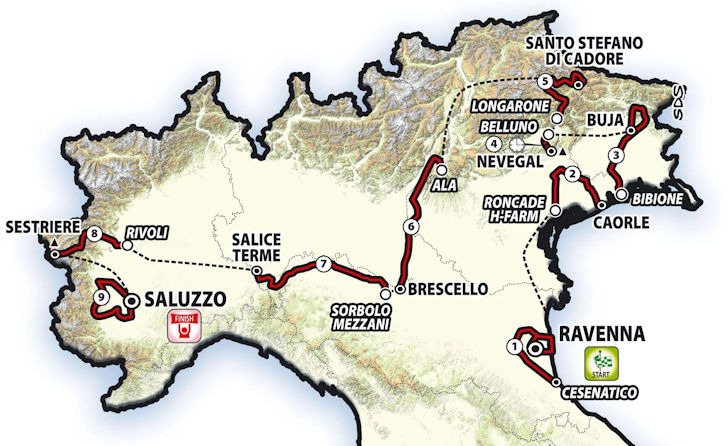
Stage-by-stage breakdown of 2026 Giro d'Italia Women
[click the italicised links for detailed stage descriptions]
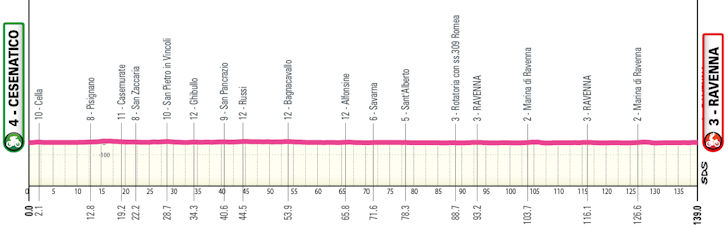
Stage 1 - 139 kilometres, 100 metres of climbing
TThe sprinters have plenty to enjoy in the opening days of the Giro d’Italia Women. Especially on the opening stage, as the pink caravan travels from Cesenatico to Ravenna on a route that could hardly be any flatter.
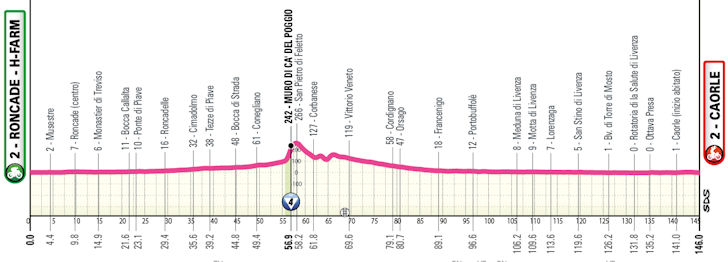
Stage 2 - 156 kilometres, 500 metres of climbing
On the second day, things once again look promising for the likes of Lorena Wiebes, Charlotte Kool and Elisa Balsamo. On the route from Roncade to Caorle, they do have to tackle the Muro di Ca’ del Poggio, but the brutal ramp comes too far from the finish to have any real impact.
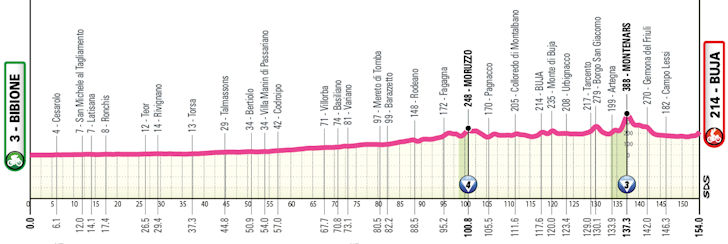
Stage 3 - 156 kilometres, 1,000 metres of climbing
The riders race from Bibione to Buja on day three. Two modest climbs along the way play a minor role, but another gentle uphill is set to ignite the race as it comes inside the final 500 metres. The finishing straight kicks up at 5.3%.
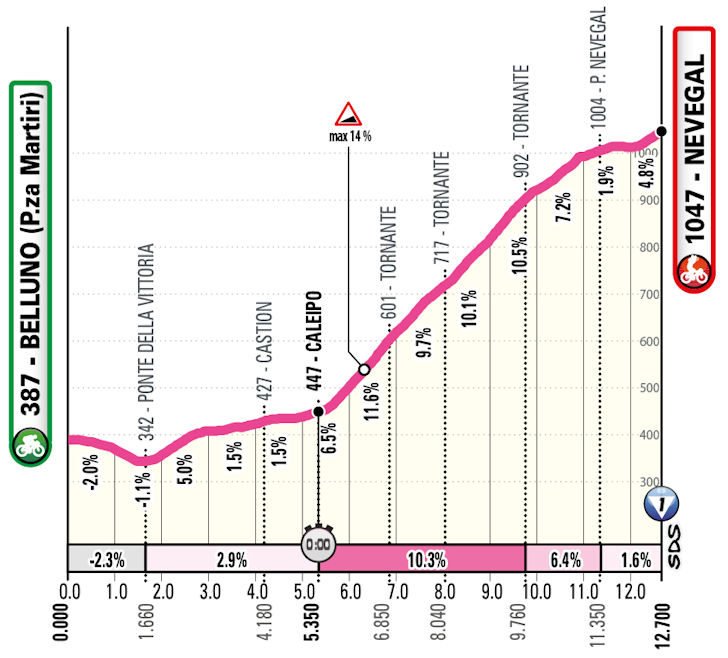
Stage 4 - 12.7 kilometres, 750 metres of climbing
Day four is an important one in the Giro d’Italia Women, as it features a 12.7-kilometre mountain time trial marked by an 11-kilometre climb averaging 6%. It is by no means a steady effort, as the steepest section rises over 4.3 kilometres at an average of 10.4%.
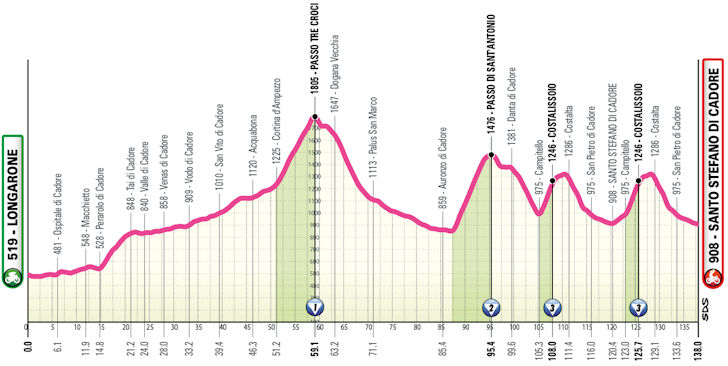
Stage 5 - 146 kilometres, 3,400 metres of climbing
The first mountain stage runs from Longarone to Santo Stefano di Cadore. On the way to a finishing circuit, the riders tackle the Passo Tre Croci (7.9 kilometres at 7.2%) and the Passo di Sant’Antonio (8.3 kilometres at 7.5%), while the closing circuit features a 4-kilometre climb at 9.1% twice. The stage then finishes with a 9-kilometre descent to the line.
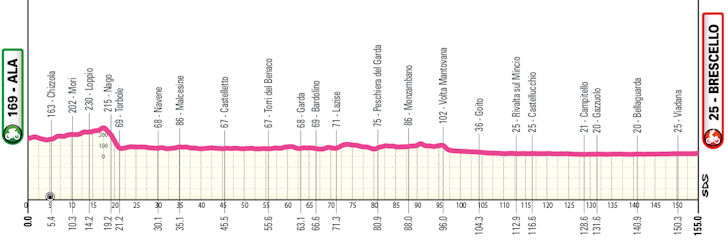
Stage 6 - 159 kilometres, 350 metres of climbing
Between Ala and Brescello there are no climbs at all. Nothing stands in the way of the sprinters taking their chance once again, unless a bike handling error in the twisty finale upsets the script.
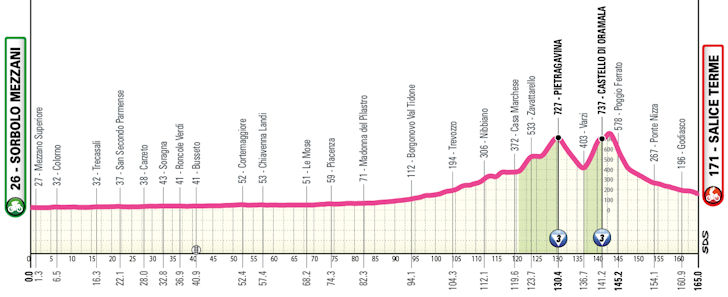
Stage 7 - 159 kilometres, 1,000 metres of climbing
The riders race from Sorbolo Mezzani to Salice Terme on stage 7. The only obstacle is the climb to Pietragavina, a 7.9-kilometre ascent at 3.2%, with the summit coming 26.9 kilometres from the finish. From there it is all downhill, though nothing too steep.
Stage 8 - 105 kilometres, 2,800 metres of climbing
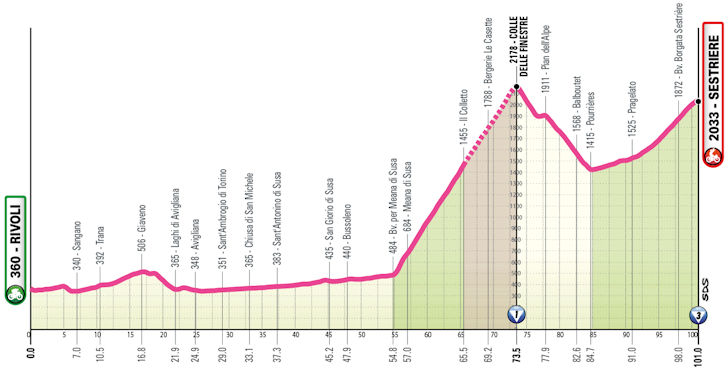
The Colle delle Finestre will be the literal and likely also figurative high point of the Giro d’Italia Women. After a flat approach, the partly unpaved monster climb rises over 18.5 kilometres at an average of 9.2% to 2,178 metres above sea level. An 11-kilometre descent then precedes the final climb to Sestriere: 16.2 kilometres at 3.8%.
Stage 9 - 145 kilometres, 2,200 metres of climbing
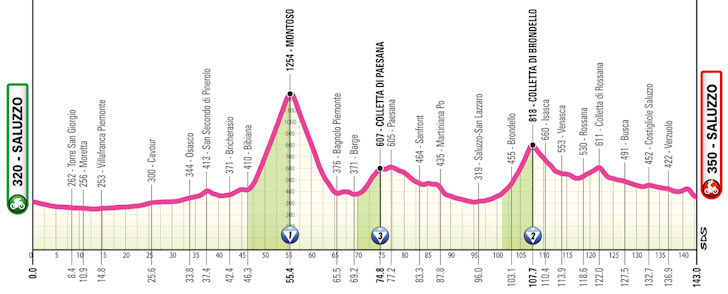
The Giro d’Italia Women concludes with a stage starting and finishing in Saluzzo. Along the way, the riders tackle the Montoso (8.9 kilometres at 9.4%), the Colletta di Paesana (3.4 kilometres at 5.8%) and the Colletta di Brondello (6.9 kilometres at 6.5%). Once over that final summit, there are still 35.3 kilometres to go to the finish. This section runs over flat to rolling roads, mostly on a slight downhill gradient.
Giro d'Italia Women 2026: route, profiles, more
Click the images to enlarge
Comment
No comments yet, please share your view!