Tour Auvergne-Rhône-Alpes 2026: Route
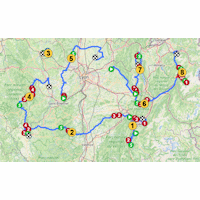
First published on 2 June 2026 - last updated 8 June: weather forecast added
Race dates: Sunday 7 June - Sunday 14 June
Race type: important warm-up race for the Tour de France
Key stages: 3, 7, 8
Favourites: Paul Seixas, Juan Ayuso, Isaac del Toro
Stage-by-stage breakdown of 2026 Tour Auvergne-Rhône-Alpes
[click the italicised links for detailed stage descriptions]
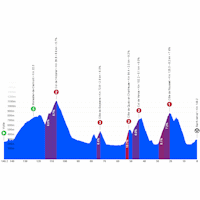
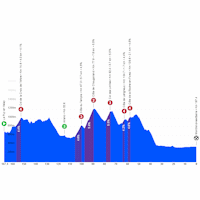
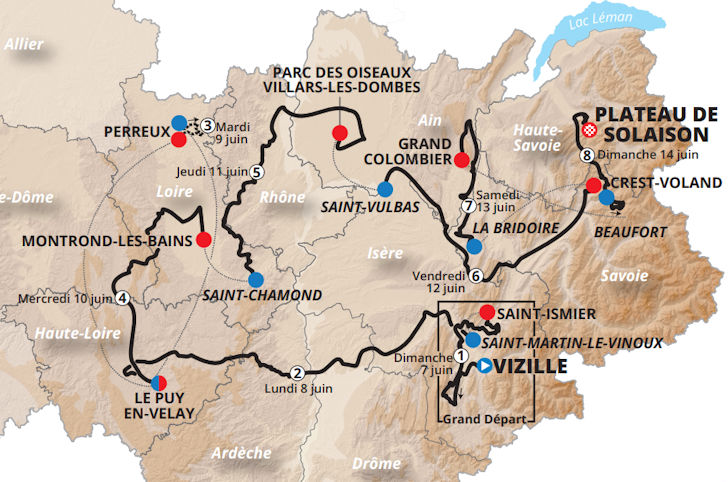
Stage 1 - 146.2 kilometres, 3,160 metres of climbing
The Tour Auvergne–Rhône-Alpes opens with a challenging hilly stage from Vizille to Saint-Ismier. The route features five classified climbs, the last of which rises for 8.2 kilometres at 7.6%, while the summit is situated just over 20 kilometres from the finish. The descent continues onto a false flat run-in to the line of 7.6 kilometres.
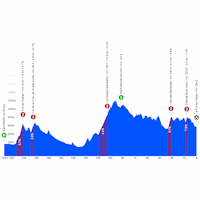
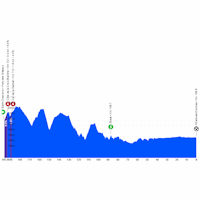
Stage 2 - 234.3 kilometres, 3,685 metres of climbing
The longest stage of the week runs from Saint-Martin-le-Vinoux to Le Puy-en-Velay. With five not overly demanding climbs, the route seems tailor-made for a group of breakaway artists. The last climb rises for 2 kilometres before the finale flies downhill.
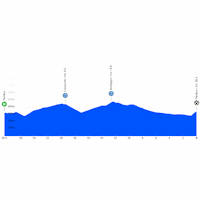
Stage 3 - 28.4 kilometres, 420 metres of climbing
On day three, the Tour Auvergne–Rhône-Alpes serves up a dress rehearsal for the its big brother, the Tour de France. Stage 3 is a rolling 28.4-kilometre team time trial in the same format as the TTT that will open the Tour de France. In both cases, the riders start as a team, but at the finish it is each rider’s individual time that counts.
Stage 4 - 167.4 kilometres, 2,250 metres of climbing
The sprinters present in the Auvergne–Rhône-Alpes region are offered just two potential opportunities to shine. The first runs from Le Puy-en-Velay to Montrond-les-Bains, but it is by no means a straightforward affair. The route is hilly and only becomes properly sprinter-friendly with around 50 kilometres to go. In the last 12 kilometres, the road is as straight as a die.
Stage 5 - 195.8 kilometres, 2,500 metres of climbing
This should definitely be a day for the fast men. The stage follows a similar pattern to the previous one: hills early on, flat towards the finish. However, the route is longer, the total amount of climbing is roughly the same, and the hilly section ends with around 100 kilometres to go, so that's perfect for a fast finishers showdown. The start is in Saint-Chamond and the finish is at the Parc des Oiseaux in Villars-les-Dombes.
Stage 6 - 182.3 kilometres, 2,850 metres of climbing
The final weekend begins with the easiest of three consecutive summit finishes. On the route from Saint-Vulbas to Crest-Voland, the riders tackle a long climb midway through the stage before the final 21 kilometres are virtually all uphill. First, the road rises for 11.5 kilometres at 5.1%, and after a short descent, the last 5.9 kilometres ascend at 7.7%.
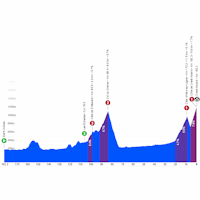
Stage 7 - 133.6 kilometres, 3,820 metres of climbing
Short and intense, and then even shorter and even more intense — that sums up the final two days of the Tour of Auvergne–Rhône-Alpes. Stage 7 starts as a hilly race before serving up two longer climbs on the run-up to the final ascent. The finish is situated atop the Grand Colombier, a brutal ascent of 8.4 kilometres at an average gradient of 10.2%.
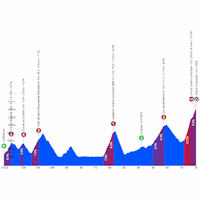
Stage 8 - 120.1 kilometres, 3,860 metres of climbing
The final stage is a compact blockbuster. Despite its modest distance, the riders still face four huge climbs. The final ascent to the Plateau de Solaison is an 11.3-kilometre slog at an average gradient of 9.1%.
Weather forecast:
Conditions look set to be ideal for the riders. Sunshine is forecast throughout the week, with only a slight chance of a shower in the finale of the 2nd stage. Even then, there is no threat of severe weather.
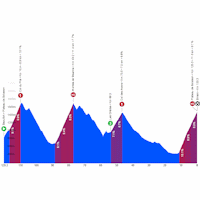
Tour Auvergne-Rhône-Alpes 2026: route, profiles, videos
Click the images to enlarge

Comment
No comments yet, please share your view!