Paris - Tours 2026: Route

Published on 3 October
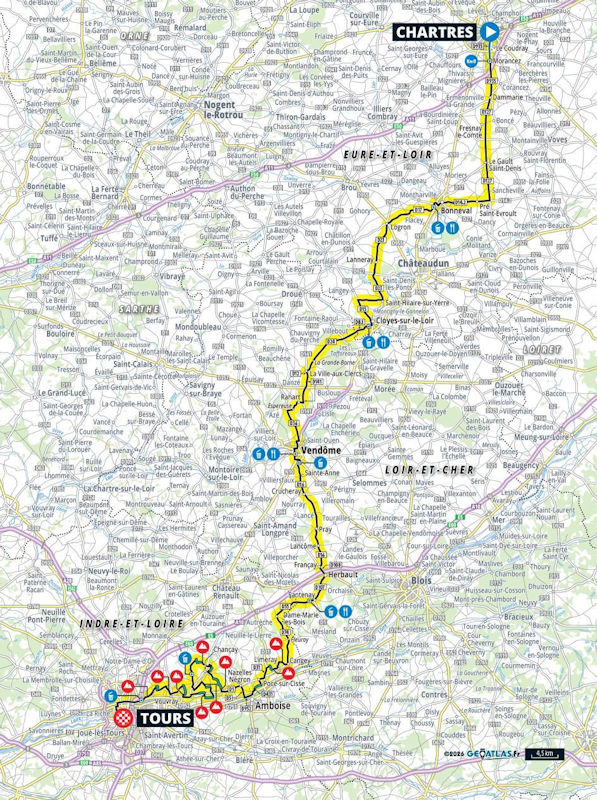
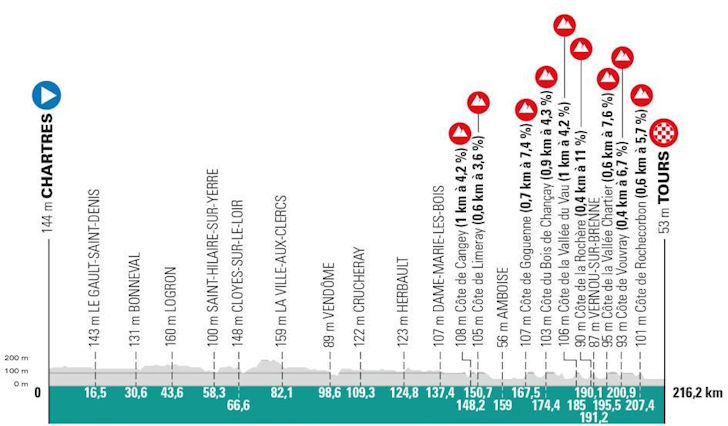
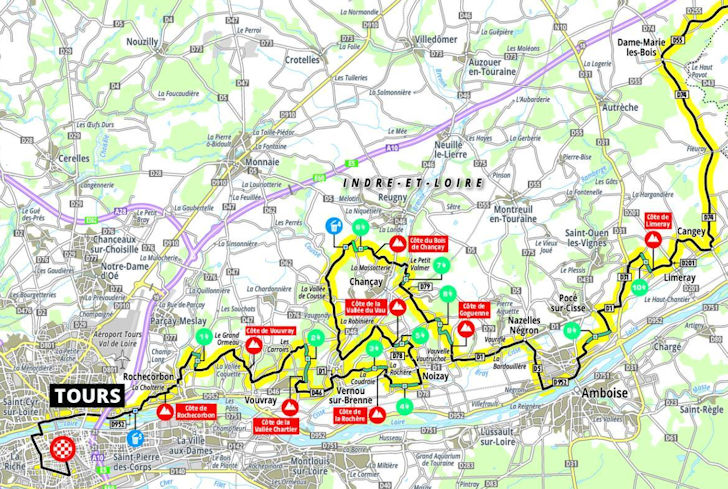
After the start in Chartres, the riders head south over rolling roads for 147 kilometres before tackling the first climb. The Côte de Cangey rises for 1 kilometre at an average gradient of 4.2%. Not long afterwards, the Côte de Limeray serves up 600 metres at 3.6%, immediately followed by the first dirt road. Another 4.7 kilometres later, near the village of Pocé-sur-Cisse, an unpaved sector of 1.1 kilometres is on the menu.
Shortly afterwards, the Côte de Gogueme - 700 metres at 7.7% - leads straight onto the Grosse Pierre dirt road. Château de Valmer is a short unpaved section on the approach to the Côte du Bois de Chançay, a 900-metre gravel climb at 4.3% that flows into the dirt road towards Reugny. When the riders pass through the village, there are just under 41 kilometres remaining.
After a period of relative calm, the final 31 kilometres are packed with obstacles. The Côte de la Vallée du Vau (1 kilometre at 4.2%) brings the Noizay gravel section in its wake, and the riders then head via the unpaved Épinettes section to the Côte de la Rochère, a short but extremely steep climb: 400 metres at 11%, followed by the 900-metre Vernou gravel section.
The Côte de la Vallée Chartier - 600 metres at 7.6% - leads onto the Peu Morier gravel section, while the Côte de Vouvray - 400 metres at 6.7% - comes before the gravel road at Rochecorbon. Just under 3 kilometres later, the Côte de Rochecorbon provides the final obstacle of the day. I's a 600-metre climb at 5.2% and the riders reach its peak 8.7 kilometres from the finish.
Last year, Matteo Trentin won Paris-Tours. He was part of a breakaway alongside 2024 winner Christophe Laporte, Albert Withen Philipsen, Paul Lapeira, Thibaud Gruel and Stefan Bissegger. The Italian got the better of his breakaway companions in the sprint.
Paris-Tours 2026: routes, profiles, videos
Click the images to enlarge



Comment
No comments yet, please share your view!