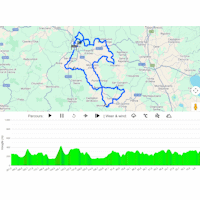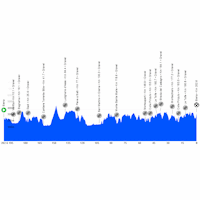
Latest update: 1 March 2026 – new route and profile maps added
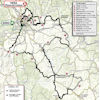
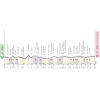
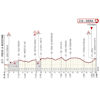
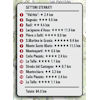
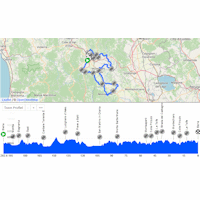
In total there are fourteen gravel sectors this time. The riders barely have time to warm up before the first one appears. It is a gentle introduction – 2.4 kilometres and flat – but after a barely noticeable stretch of tarmac, the next sector delivers 4.8 kilometres of climbing. Straight after the descent, the peloton tackles a rolling 4.4-kilometre stretch, after which things settle down for a while.
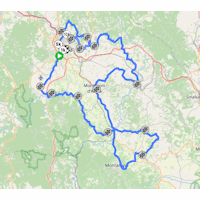
Strade Bianche is almost 50 kilometres underway when the road rises on smooth tarmac towards Montalcino. The climb to the fortress town averages 5% over 4 kilometres.
After a high-speed descent of roughly 10 kilometres, the riders hit the longest sterrato of the day. It measures 11.9 kilometres and finishes with a short descent. Almost immediately afterwards, sterrato 5 serves up another 8 kilometres of gravel, with plenty of ups and downs thrown in.
Following a phase on asphalt, the peloton enters the 9.5-kilometre sector of San Martino in Grania, largely uphill and ending with a steep, twisting climb. A 9-kilometre descent then leads onto sterrato 7 – arguably the toughest sector of the day. Over 11.5 kilometres, the gravel road climbs relentlessly, while also featuring some tricky descents.
Over the next 18 kilometres the surface is smooth tarmac, which may sound easier than it is, as the road constantly rises and falls. Then four sterrati await within just 16 kilometres.
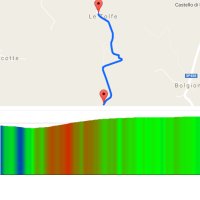
Sterrato 8 is only 600 metres long, but spiced up with a climb in double figures. Not long after, the 2.4-kilometre Strade di Colle Pinzuto opens with a brutal gradient of around 15%. And it does not really flatten out afterwards, as a series of hairpins continues the ascent. A descent then takes the riders to the foot of the sterrato that, together with Colle Pinzuto, is tackled twice: the punchy climb to Le Tolfe. Soon after comes the 700-metre Strade del Castagno.
Via 14 kilometres of rolling asphalt, the riders reach a descending 3.3-kilometre sector. It leads into Vico d’Arbia, where they passed 30 kilometres earlier, meaning familiar roads now lie ahead. First the unforgiving Colle Pinzuto, then the brutal climb to Le Tolfe.
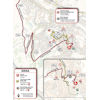
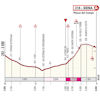
The Le Tolfe sector is the final gravel road of Strade Bianche: 1.1 kilometres long and finishing with an 18% ramp. After passing the chapel at the top, there are still 12 kilometres to Siena. Although all on asphalt, the route is far from flat. Attackers hold the advantage, as the chasers rarely have them in sight on a constantly climbing, descending and twisting run towards Siena.
With 4.5 kilometres to go the road descends, before rising again over the final 1.7 kilometres. First a false flat, then, upon entering Siena’s old town, the route continues over the rough, steep cobbled slabs of Via Santa Caterina. This section climbs at 12% over 500 metres and delivers a 16% ramp right at the end. Then a sharp right turn, left, right again – and the winner celebrates across the line on the Piazza del Campo.
Siena’s famous square feels almost like a theatre. There is no better stage on which to finish one of the most photogenic races of the cycling season.
Fancy riding the route yourself? Download GPX Strade Bianche 2026.
Strade Bianche 2026: routes, profiles, videos
Click on the images to zoom