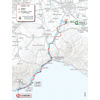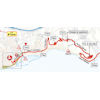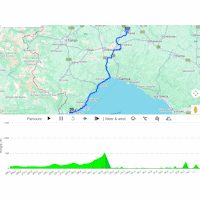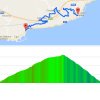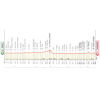
Just like the past two years, the peloton sets off from Pavia, a small town 30 kilometres south of Milan in the Po Valley. After a local circuit, the riders head south on the only part of the route that differs from last year. After passing through Voghera, around 60 kilometres into the race, the course becomes a replica of last year’s.
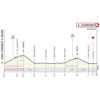
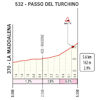
After roughly 100 kilometres, the road begins to rise gently towards the Passo del Turchino — an endless false flat with the final 1.5 kilometres averaging 6.5%. The summit comes around halfway through the race and the riders then plunge down towards the Mediterranean.
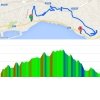
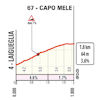
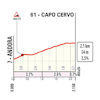
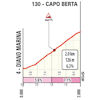
Once on the coast, a righthander take the riders on the flat towards the three capi: Capo Mele, Capo Cervo, and Capo Berta. They’re famed, but not because of their difficulty – it’s a fact that the finale is approaching.
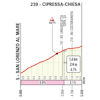
After Capo Berta, with just under 40 kilometres remaining, the tension intensifies. It reaches boiling point when the riders arrive in San Lorenzo al Mare, at the foot of the Cipressa. The climb is 5.5 kilometres long, with an average gradient of 4.1%. The first casualties are usually pure sprinters with sour legs, who get dropped on the steepest section just after the halfway point.
Last year, the damage on the Cipressa was far more devastating, as Pogacar had decided to open up the finale early, and only Van der Poel and Ganna could follow. The rest of the field was already spent on the Cipressa, with roughly 25 kilometres still to go.
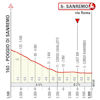
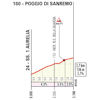
After the descent, it’s around 8 kilometres to the foot of the Poggio. The climb is 3.7 kilometres at 3.7%, with a steepest section of 8% one kilometre from the top. Hardly Stelvio-level, but because Pogacar and Van der Poel attacked it last year in such a ferocious manner, Ganna struggled and lost contact.
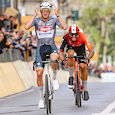
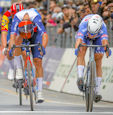
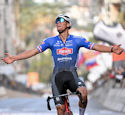
Just before the summit, Van der Poel opened a small gap, but Pogacar closed it. Then, as Ganna managed to latch back on just after the flamme rouge, the race came down to a three-man sprint on the Via Roma. After a brief surplace, Van der Poel launched his sprint with 300 metres to go. He immediately went clear and held on to the line, winning La Primavera for the second time in three years. Ganna finished second, Pogacar third.
Fancy riding the route yourself? Download GPX Milan-San Remo 2026.
Milan–San Remo sets off at 10:00 and the race is expected to finish around 16:55 – both local times (CET). For full details, see the schedulde times in the slideshow below this article.
Milan-San Remo 2026: routes, profiles, videos
Click on the images to zoom